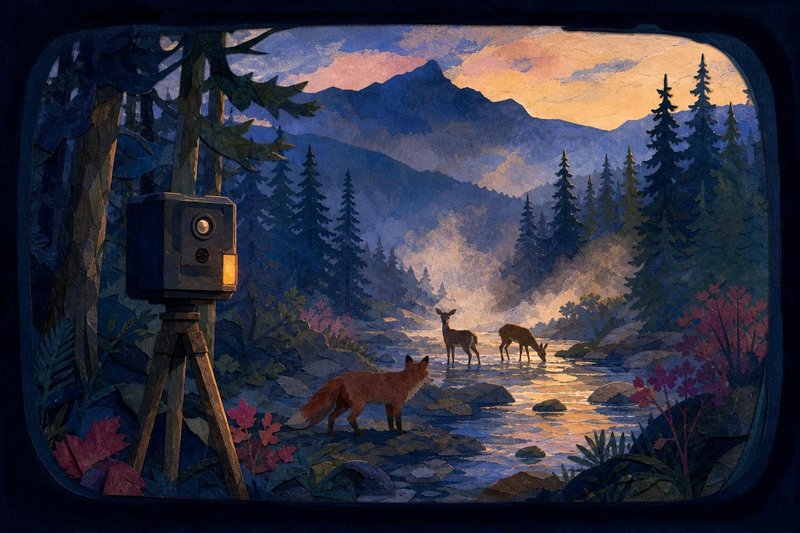
This list is a programme, not a ranking: the kind an open-air cinema might put together for a summer devoted to nature. It runs from the films that invented the genre to the ones you would stream on a weeknight, and it ends with prize winners from Ecocinema, the environmental film festival held in Greece between 2001 and 2008. The Greek edition of this page has a longer list, including Greek documentaries.
Classic environmental documentaries
The films that taught cinema how to look at nature, and that still hold a room.
- Nanook of the North1922 · Robert Flaherty
An Inuit family on Hudson Bay: hunting, an igloo, the ice. One of the first feature-length documentaries.
- The Silent World1956 · Jacques-Yves Cousteau, Louis Malle
The first great colour look under the sea. Palme d’Or and Oscar; some scenes with animals are now hard to watch, which is part of the lesson.
- Koyaanisqatsi1982 · Godfrey Reggio
No narration, only images and Philip Glass’s score: deserts, dams, motorways, crowds.
- Microcosmos1996 · Claude Nuridsany, Marie Pérennou
A meadow at insect scale. Ideal for children, as it needs almost no words.
Documentaries on climate and politics
When the camera turned from nature to the people changing it.
- Darwin’s Nightmare2004 · Hubert Sauper
Nile perch in Lake Victoria and the chain linking one fish to hunger, arms and exports.
- An Inconvenient Truth2006 · Davis Guggenheim
Al Gore’s climate lecture turned Oscar-winning film. Some figures are dated; the storytelling is not.
- Chasing Ice2012 · Jeff Orlowski
James Balog’s time-lapse cameras record glaciers retreating within a few years.
- The Salt of the Earth2014 · Wim Wenders, Juliano Ribeiro Salgado
Sebastião Salgado’s life, ending with the replanting of a forest on his family’s farm in Brazil.
Newer nature documentaries
More personal films built on a relationship: a diver and an octopus, a woman and her bees.
- Honeyland2019 · Tamara Kotevska, Ljubomir Stefanov
A wild-bee keeper in North Macedonia who always leaves half the honey for the bees. Two Oscar nominations.
- My Octopus Teacher2020 · Pippa Ehrlich, James Reed
A year of daily visits to one octopus in a South African kelp forest. Oscar for best documentary.
- David Attenborough: A Life on Our Planet2020 · Alastair Fothergill, Jonnie Hughes, Keith Scholey
Sixty years of filming, and what has been lost in that time. The last part is about solutions.
Prize winners from the Ecocinema festival
Documentaries that won at the Greek environmental film festival and are still easy to find.
- The Corporation2003 · Mark Achbar, Jennifer Abbott
The modern corporation examined as if it were a patient. First prize, Ecocinema 2004, Rhodes.
- Our Daily Bread2005 · Nikolaus Geyrhalter
Industrial food production with no commentary and no music. Best film, Ecocinema 2006, Athens.
- Manufactured Landscapes2006 · Jennifer Baichwal
Edward Burtynsky photographs China’s factories, quarries and dams. Shared first prize, Ecocinema 2008, Piraeus.
Showing a documentary to a class
Pick a film under ninety minutes, or one episode of a series. Give a single question before the screening rather than a worksheet, for instance: what changed in the landscape from the first scene to the last? Then give the discussion at least as much time as the introduction. In environmental education, a film works better as the start of a project than as a reward at the end of it.
Pairing two films from different decades works well with older students. Nanook of the North next to Honeyland puts a family and its environment side by side, filmed almost a century apart; Koyaanisqatsi next to Our Daily Bread sets two wordless films about the industrial world twenty-odd years apart. Either pairing doubles as a first lesson in how a documentary is built: where the camera stands, what is left out of the frame, and why some films choose to say nothing at all. For younger classes, Microcosmos and My Octopus Teacher need almost no preparation.
Frequently asked questions
Which environmental documentary should I watch first?
Chasing Ice if you want one film that shows rather than explains. For children, Microcosmos.
Are these suitable for school screenings?
Most are. Darwin’s Nightmare has harsh images, and The Silent World needs a conversation about how its crew treats animals.
Where can I watch them?
Availability changes by country and month. Platform-produced titles such as My Octopus Teacher tend to stay in their catalogue; festivals and summer open-air cinemas remain the best big-screen option.
Which of these documentaries won prizes at Ecocinema?
Three of them: The Corporation (first prize, Rhodes 2004), Our Daily Bread (best film, Athens 2006) and Manufactured Landscapes (shared first prize, Piraeus 2008). Every edition’s winners are on the Ecocinema festival page.